

This Thing We're All Avoiding? It's the Thing That Actually Helps
Probably not what you want to hear, but maybe what you need


Duck Syndrome is a free weekly newsletter for overwhelmed perfectionists and anxious over-thinkers appearing to have it all together while frantically paddling under the surface. It is written by therapist Carrie Smolen, who works with clients all over California, specializing in perfectionism and body struggles (including eating disorders). Thank you for supporting Duck Syndrome by reading, liking, subscribing, sharing, commenting, and helping this community of ducks to grow.

I’m so sorry to be the one to tell you this, though I doubt I’m the first: you have to feel your feelings if you want to move through them. I know, it sucks. Even as a therapist, I’m not always super into feeling mine either.
I don’t know about you, but I feel absolutely inundated with reminders of this hunger that people seem to have for figuring out how to optimize themselves right now. Drink this, don’t eat that, buy this to fix that, sleep this much but not more than that much, and do it by making sure that you never this, but definitely do wear that, but not too close to when you’re unplugging from this, but use an app for that, and definitely boost your this, so that your hormones can that. Do all of it perfectly and THAT is how you will feel… better.
We all want to feel better. Things do not feel good right now. What’s happening nationally and globally is a backdrop for everything else we’re experiencing, which only serves to heighten how intense all of our day-to-day stressors feel. Of course you’re trying to research routines and habits and products and supplements and whatever else that might be the thing that finally gives you a sense of relief. And I don’t know about you, but I’m so tired of all the things I’ve been feeling. Exhaustion, overwhelm, anxiety, sadness, fear, burnout, tension, frustration, anger, numbness… it’s all unrelenting. And it’s been seemingly unending. I really do understand the impulse to try to do whatever you can to not let these emotions get the best of you. To fight them off. To distract yourself. To push through.
The unfortunate thing though? That almost never truly works.
I use a lot of metaphors and imagery in my therapy practice, and one that comes up a lot with my clients is the idea that feelings are like finger traps. You know, the kind you can win at an arcade? Like this:
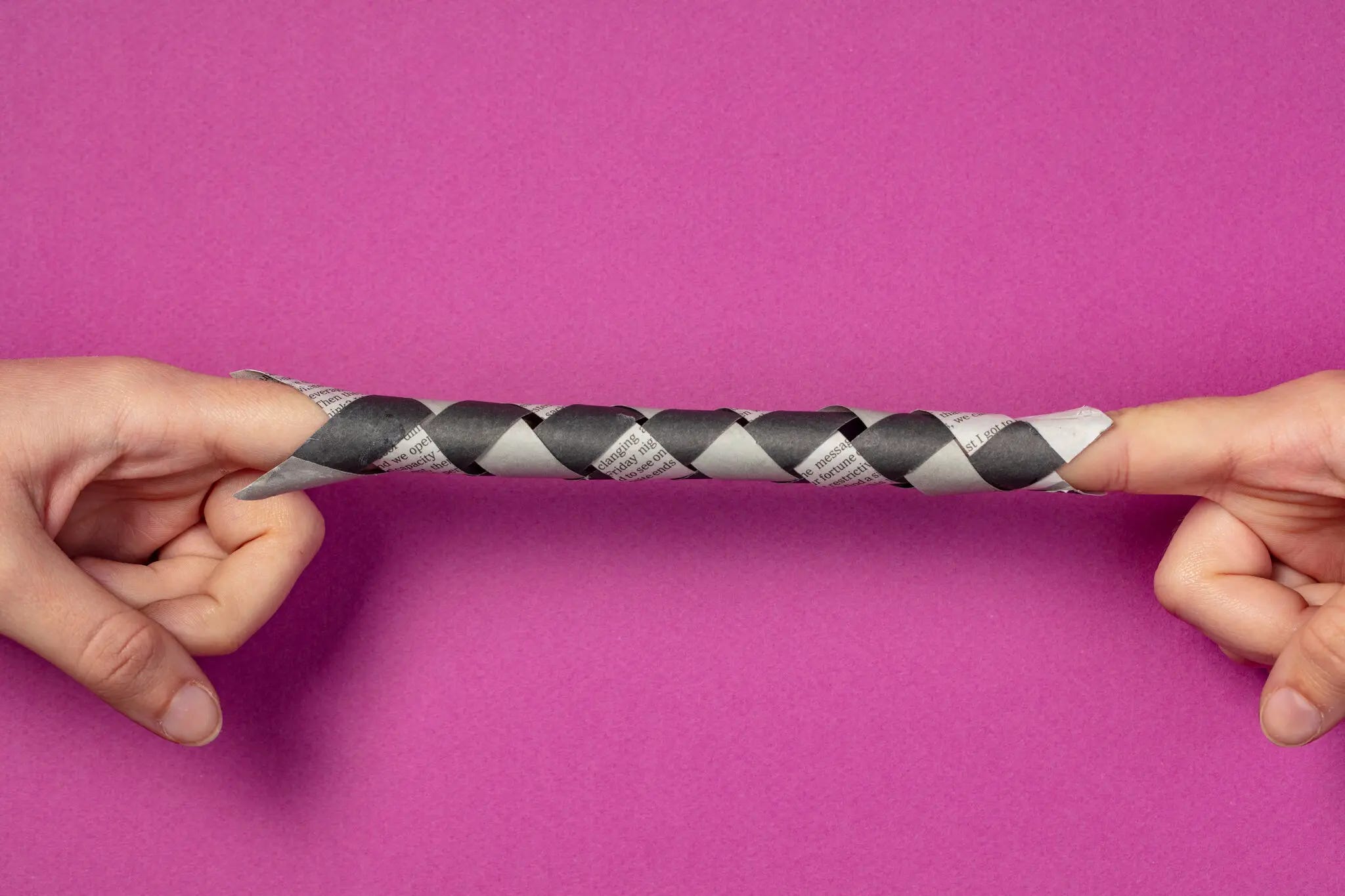
You can probably see where this is going. The more you try to pull away, the tighter its grip gets. Feelings tend to work similarly; the more you try to deny them or rush them or fix them or just generally avoid feeling them, the more they consume you. The way out of a finger trap is to push your fingers closer together. Move toward its center, instead of away. It’s deeply counterintuitive, just like it is to lean into those uncomfortable emotions.
Especially for anyone who has experienced depression, it can feel so scary to “give in” to those sensations. My clinical opinion though, is that depressive symptoms don’t appear or worsen when you allow yourself to engage with your emotions. Not even sadness. In fact, often when we experience common elements of depression (numbness, emptiness, lack of joy/pleasure, exhaustion, worthlessness, etc.), it’s because our brains are trying to protect us from feeling our feelings.
Many of us grow up internalizing messages about which feelings are and aren’t safe to feel. This of course varies widely depending on all kinds of contextual factors. Still, especially in white cishet patriarchal culture, it often manifests as people assigned male at birth (“boys”) being taught that “softer” emotions like fear and sadness and are unacceptable, while people assigned female at birth (“girls”) were brought up not “allowed” to be angry. We develop all kinds of strategies, often outside our own awareness, to avoid engaging with these sensations. We label these (and frequently all challenging feelings) as bad. We treat them like they need to be kept at bay, and like they aren’t welcome parts of our day to day experience. And when we do have periods when we acknowledge that we’re feeling a certain way, we label those times as “off” or “dark” or “low” and put our energy into to trying to get “back to normal.”
But what if feeling feelings, even when it’s inconvenient, even when it “gets in the way” of our regularly scheduled programming… is part of “normal”? What if the goal weren’t to muscle through a “hard stretch” as fast as possible? What if it were feasible to sit with and in an emotion… and to just let it be there? To stop trying to chase it away? To recognize that it eventually WILL leave, if only for a little while, even if we don’t push it out the door? To remember that all things, even the most incessant, are temporary.
To me, this idea is of course a bit daunting, but it’s also… kind of a relief? I feel a deeper exhale than I’ve been able to access recently, when I think about allowing myself to stop putting so much energy into trying to get to the end of this challenging moment. It takes a lot of effort to power through. Plus, rejecting hard feelings isn’t the key to opening up room for pleasurable ones. You can’t experience things like joy, calm, or excitement when you’re trying to suppress your ability to feel at all. Unfortunately, most of the time it’s not possible to pick and choose which feelings to let in. As much and I advocate against oversimplification and black-and-white thinking, I do think that there is a bit of of an all-or-nothing lens that can be applied here. If we focus so hard on rejecting the “bad” feelings, we risk leaving no room for the “good” ones too.
So how do you actually do it? That will of course depend on who you are and how you tend to process things. I’m very much a verbal processor. I gain so much clarity from listening to myself talk about how I’m feeling, and especially from having someone help me to tease it all out. Of course, I’m an advocate of utilizing a therapeutic relationship for that exploration, but any trusted confidant could be helpful for you instead or in addition. Others really benefit from a more internal process, so maybe it looks more like journaling or meditation. Many people process through creative expression and/or movement. It could also look like watching sad movies when you’re sad or listening to angry music when you’re pissed off. There is no “right” way to feel your feelings. It may take some experimentation and playing around. It could also be a combination of some or all of these things and more. And even simply trying to tap into which of these ideas just sounds the best or most palatable to you could be helpful information for at least finding a starting point.
Finally, I just want to emphatically validate how hard this can be for so many of us. It’s a major focus of the work I do with several of my clients. We all have so many reasons that we have historically struggled with leaning into feeling. Anxious people (like many self-identified ducks) especially tend to have a hard time getting out of our heads in order to better connect to our affective experiences. This can be even more challenging depending on intersectional factors like neurodiversity and social location. But just because something is difficult does not mean that it is impossible. And you do not have to figure out how to do it all alone.
As always, I’d love to hear if any of this resonated for you. Sending all who need and want it a big virtual squeeze.
*Safety Disclaimer: If for any reason it feels not just hard to access your emotions, but genuinely unsafe, please do not push yourself beyond your own limits, especially without support. Retraumatization is a risk, and not at all the goal of what I’m talking about here. If you think you might struggle with distinguishing attempting to feel your feelings from potentially re-experiencing traumatic moments or events, please seek help from a trained professional to help you connect with your emotions rather than attempting to do this sort of work on your own.

If you’re a California resident and want individual support working through perfectionism, overwhelm, body struggles, eating disorders, or other duck troubles, I offer virtual therapy across the state.
And if you are in need of immediate support, please consult this list of crisis warm lines or this list of community-based alternatives to police in your city for emergency help.
Love the finger trap metaphor. We need to lean into the feeling instead of stuffing away. I always think of that “going on a bear hunt” children’s song…”can’t go under it, can’t go around it, gotta go through it.” Sigh.